How to Crop an SVG for Pen Plotting
Cut vector paths at a crop boundary, compare geometric cropping with clipping, and export an SVG using a downloadable practice drawing.
By DrawingBots · Published
Crop paths, not just the preview
A pen plotter follows vector paths. An SVG clipping mask can hide the ends of a line on screen while leaving the original line intact. Software that ignores that mask may still send the whole line to the plotter. Geometric cropping trims the actual paths at a boundary.
DrawingBots’ SVG Cropper performs a geometric crop. Use it to frame a line drawing, crop a dense pattern, or keep paths inside a chosen outline. It prepares artwork; it does not send commands to a machine.
Start with the practice drawing
The sample below is a corgi photo converted with the Image to SVG Flow Field algorithm and sorted in SVG Optimizer. It is a typical plotter file: 5,551 short open paths, about 11,300 points, 312 KB, on a 768 × 576 unit page declared as 20.32 × 15.24 cm. Cropping it is a realistic test because every path crosses the boundary somewhere.
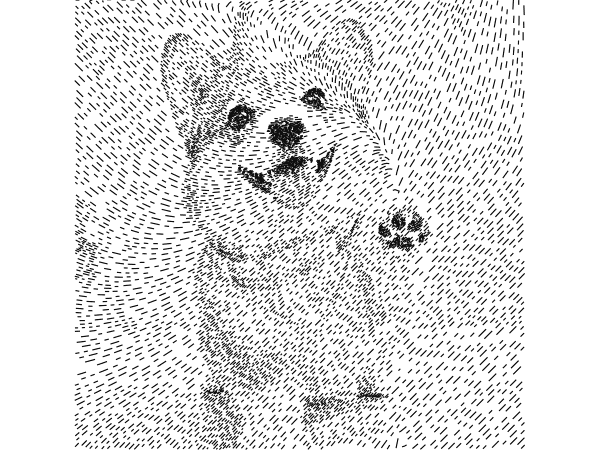
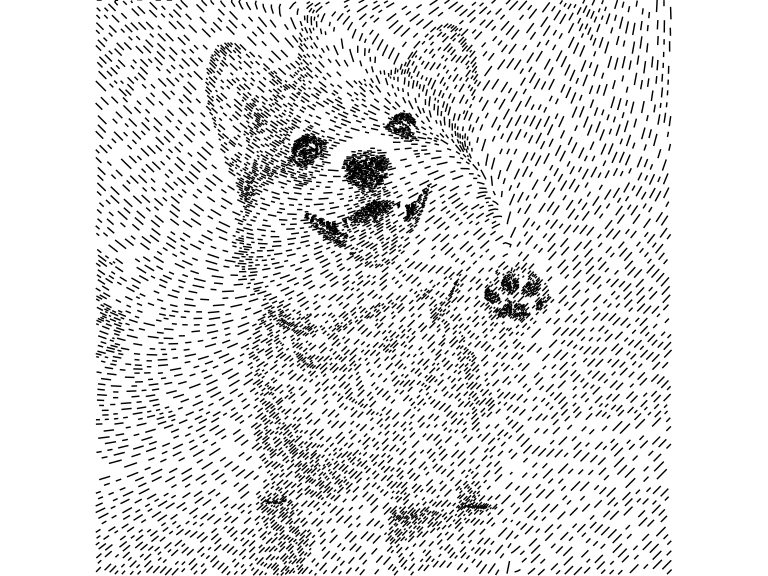
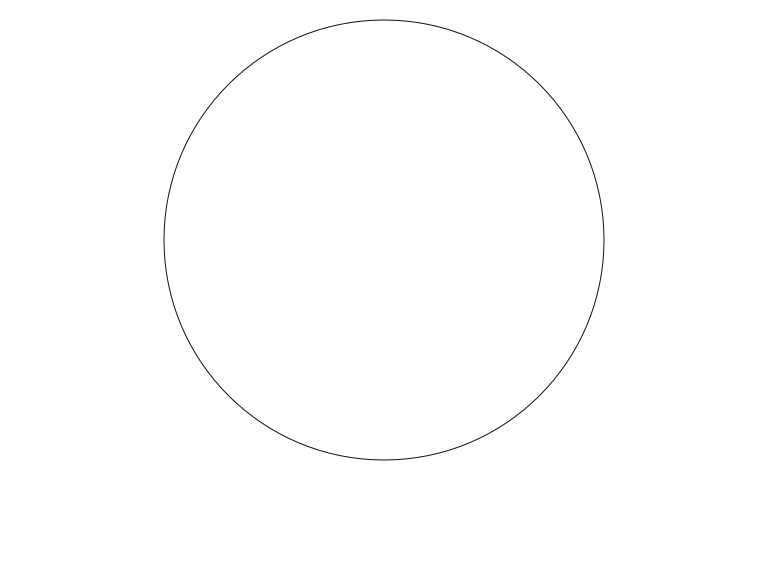
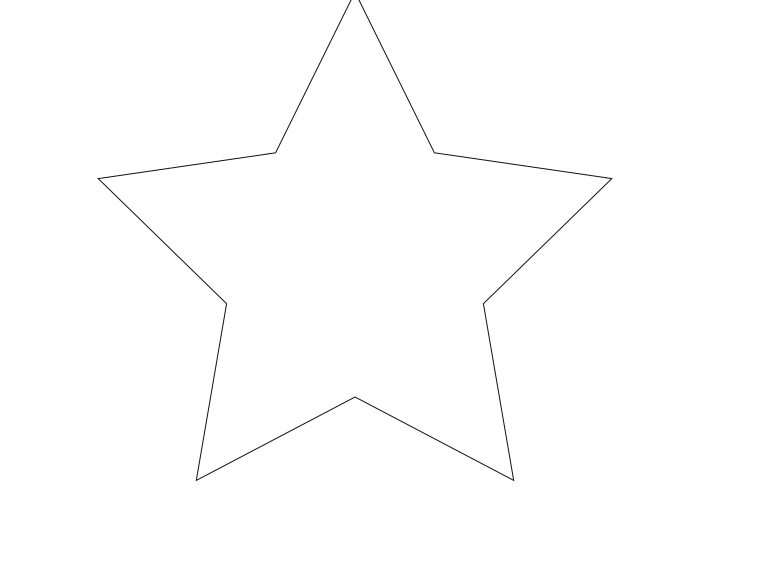
Two crop boundaries on the same 768 × 576 page are also available: a circle centred on the dog’s face and a five-point star centred on the face. Keep a copy of the source: cropping discards everything outside the boundary.
Upload, crop, and export
- Open SVG Cropper and select Upload SVG file…. Choose
dog-flowfield.svg. The drawing appears at its pixel size with a 200 × 200 crop rectangle in the corner. - Leave the source Closed Path setting off: the dashes are open line work.
- Choose a Cropper type. Rectangle, Circle / Ellipse and Polygon give you a handle box to drag and resize over the drawing; Custom Shape lets you click an outline point by point; SVG File takes an uploaded outline. For the exact result below, choose SVG File, click Upload cropper SVG… and load
crop-circle.svg. - Leave the optimization toggles off for the first comparison. Click Crop. The sidebar reports the path count and shows a thumbnail; lines that crossed the circle now end exactly on it.
- Download the result with Download SVG. Reopen it in your plotting software and check the page size before plotting.
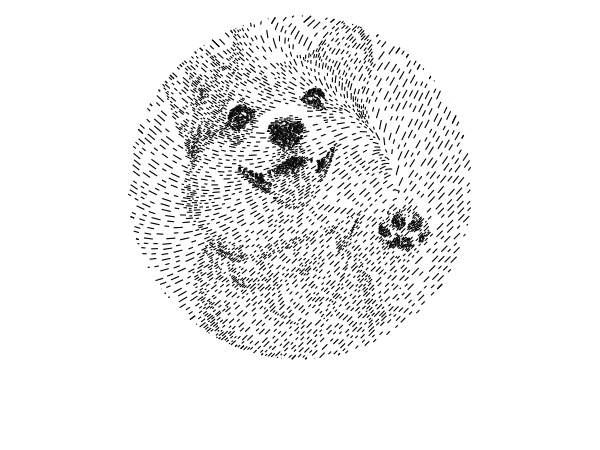
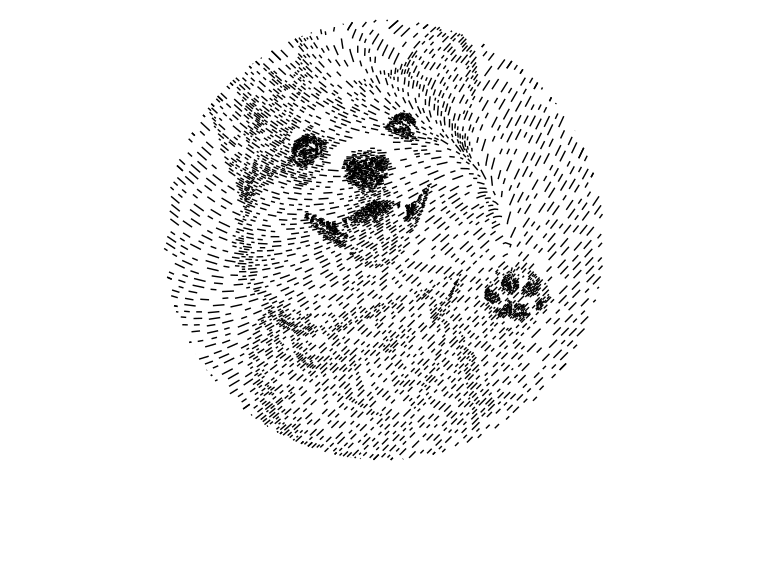
The result preview zooms to the cropped geometry. A tighter preview does not mean the exported page has been resized to the crop. Check the exported dimensions before positioning paper.
Circle, star and custom shape compared
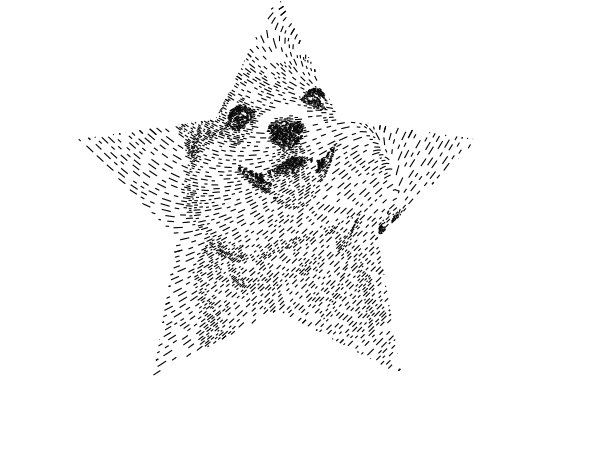
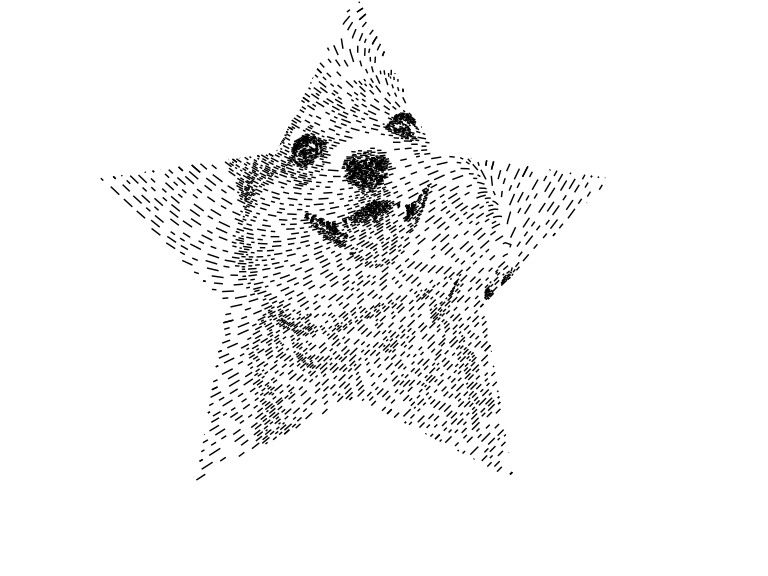
The same source through three boundaries. Each figure was produced by the tool with default settings and no optimization; the counts come from the downloaded files.
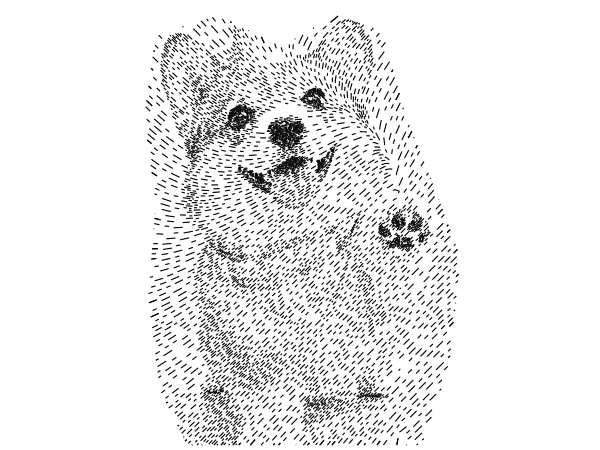
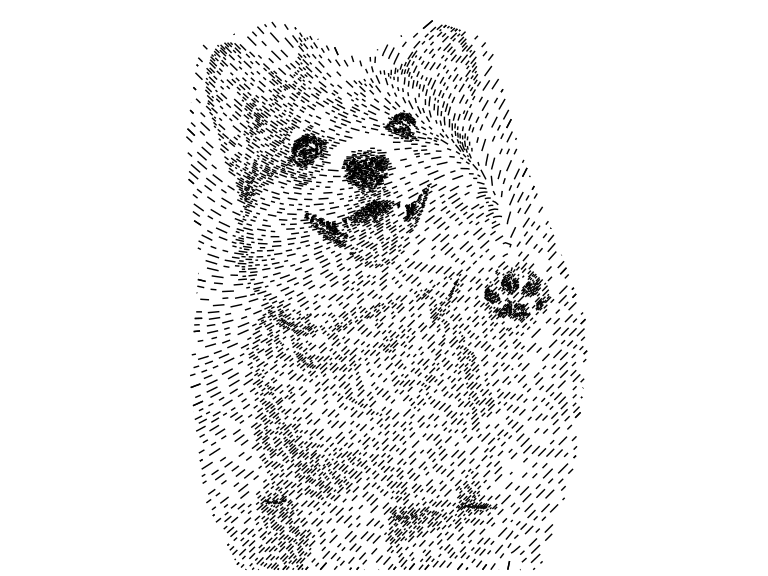
| Boundary | Paths | Points | File size |
|---|---|---|---|
| Uncropped source | 5,551 | 11,305 | 312 KB |
| Circle | 3,457 | 7,039 | 155 KB |
| Five-point star | 2,642 | 5,358 | 119 KB |
| Custom shape | 4,277 | 8,687 | 192 KB |
Every path in this file is a two-point dash, so the path count is also the number of pen strokes and the best guide to plot time: the star keeps 48% of the strokes, the circle 62%, the custom outline 77%. File size follows the same ratio. A dash cut by the boundary becomes a shorter dash rather than disappearing, which is why the edge stays crisp even though nothing was redrawn.
The Custom Shape type is the most useful for portraits. Click around the subject on the canvas, use Clear to start over and Save shape to download the outline so you can reuse it as an SVG File boundary on another drawing.
Choose a shape and preserve detail
The cropper supports a rectangle, circle/ellipse, polygon, custom shape made by clicking points, or an uploaded SVG outline. A custom shape needs at least three points. Polygon controls set the side count and angle.
For filled artwork, Closed Path treats source paths as closed regions. It reveals additional controls: Quality adjusts intersection precision, Clean Path removes nearby points and small artifacts, Lighten Path reduces points within a tolerance, and Simplify Path resolves self-intersecting outlines. These controls can alter details, so compare the result after each change.
For line work, Merge Lines can join nearby endpoints; too large a tolerance can bridge intentional gaps. Simplify Lines reduces points but can change curves. Sort for Plotting changes drawing order to reduce travel. Start with the simplest settings that preserve your artwork.
Check common cropping problems
- Empty result: check that the boundary overlaps your paths. For an uploaded boundary, check its coordinate system and placement.
- Unexpected closing lines or filled regions: check the source Closed Path setting. Open strokes and closed shapes need different treatment.
- Lost details: reduce cleaning or simplification tolerances and compare with the source.
- Missing text or image content: prepare real vector paths first. A photo embedded in an SVG is still a raster image. Follow the image-to-SVG guide or create single-line text as appropriate.
- Wrong physical size: check the document units and scale in the receiving software; do not infer size from the browser preview.
For further path preparation, try SVG Optimizer. Always inspect the exported geometry after optimization. The examples here demonstrate browser-generated SVGs, not a tested physical plot.